Things I Wish I Knew Before Starting an eBay Store
Starting an eBay store seems pretty simple from the outside.
Take pictures. List item. Sell item. Infinite money glitch?
At least that’s what I thought.
What I quickly learned is that there are a lot of little lessons nobody tells you when you’re first getting started. Most aren’t complicated, but they can be surprisingly expensive if you learn them the hard way.
Free Shipping Isn’t Actually Free
One of the first decisions I made was offering free shipping on almost everything, and I still do to this day.
Part of that was because I’m a buyer myself. Whenever I shop on eBay, I almost always filter by Buy It Now and Free Shipping. I don’t love auctions unless we’re talking sports cards or collectibles, and I definitely don’t enjoy paying extra for shipping.
If I saw two similar listings and one included free shipping, I’d usually gravitate toward that one. So when I started selling, I figured other buyers probably thought the same way.
Turns out I wasn’t wrong.
Nearly all of my listings have been Buy It Now with free shipping, and I don’t see that changing anytime soon. My mindset was simple: if someone wants it today, why make them wait seven days for an auction to end?
I wanted inventory moving as quickly as possible. Fast sales meant cash flow, and cash flow meant I could buy more inventory and keep the cycle going.
Rinse and repeat.
Dollar, dollar bills y’all. (Shout out Kenny Powers.)
The problem is that “free shipping” isn’t free.
It’s coming out of your pocket.
When you’re new, it’s easy to focus on what you paid for an item and what you’re selling it for. What many sellers forget is that shipping can completely change the math.
A sale that looks profitable can quickly become a break-even transaction… or worse.
The $20 Star Wars Lego Set That Humbled Me
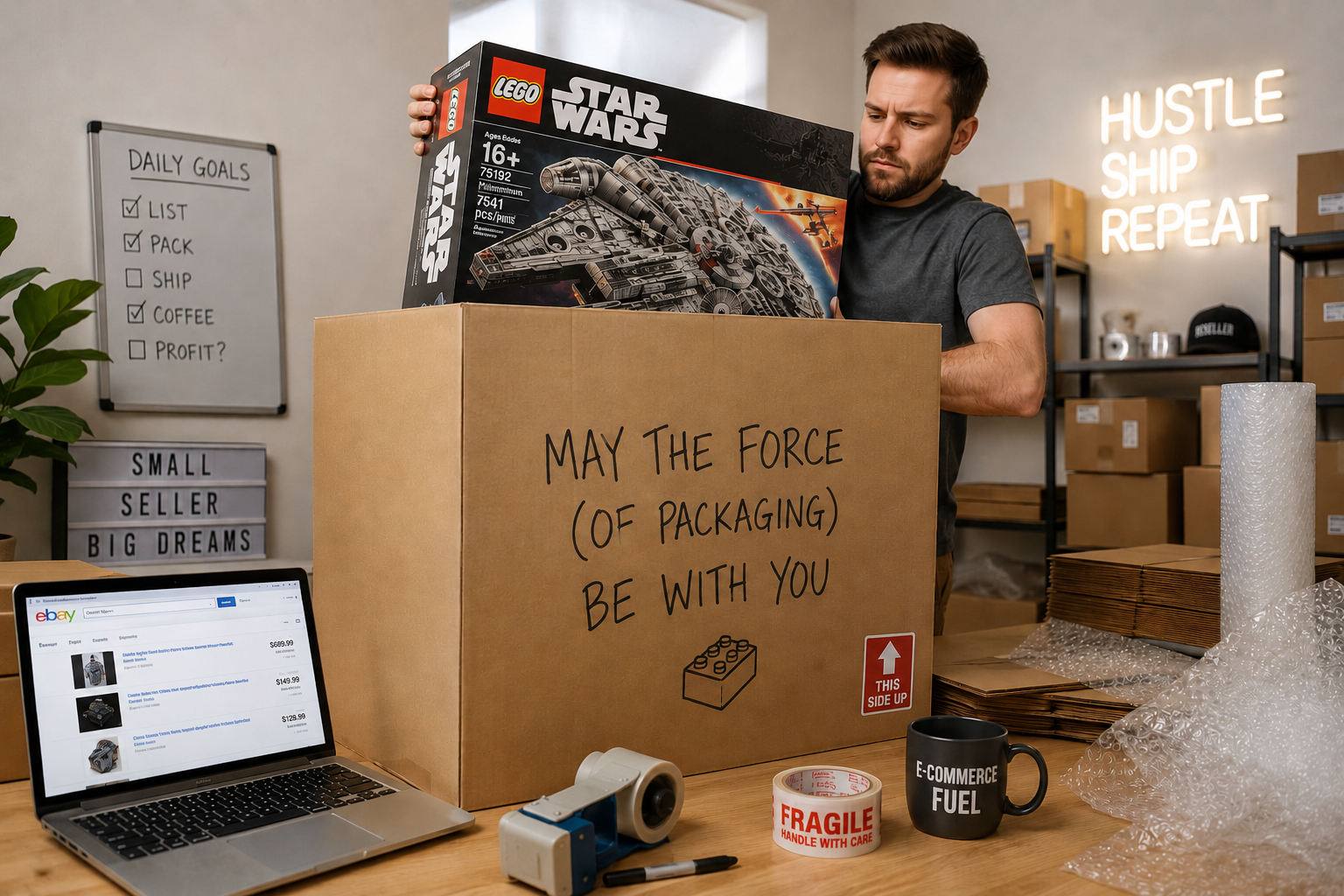
One of the first items I sold was a large Star Wars Lego set I found on clearance at Walmart.
I paid around $20 for it and listed it on eBay for roughly $100. In my mind, I had already spent the profit.
Quick flip. Easy money.
Then reality showed up.
First came eBay’s fees. I remember thinking, “Wait, eBay gets around 13% of the sale just for posting this on their website?” It felt a little rich at the time, but that’s the cost of doing business.
Then I packaged the Lego set into a giant box from Home Depot and took it to the post office.
What I didn’t realize at the time was how dramatically shipping costs can change based on the size of the box. Looking back, I probably could have found a smaller box and saved a decent amount of money, but I simply didn’t know any better.
The shipping quote was somewhere around $70. At that moment I should have stepped out of line, gone home, and taken my medicine. Instead, I was high-key too prideful to walk out of the Post Office carrying a giant box after waiting in line.
Mission failed.
So I paid it.
By the time everything was said and done, my amazing $20-to-$100 flip wasn’t much of a flip at all. Between eBay fees and shipping costs, I had somehow managed to lose money.
I remember driving home thinking:
“How dumb do you gotta be to lose money selling something for five times what you paid?”
The answer was simple.
I wasn’t calculating shipping, eBay’s cut, or much of anything else for that matter.
Looking back, that sale was probably one of the best things that could have happened to me. Losing money on a $20 clearance Lego set hurt, but it taught me a lesson that would have been a lot more expensive to learn on a $500 item.
Learn Your Numbers Early
That Lego sale taught me one of the most important lessons in ecommerce.
Revenue doesn’t matter nearly as much as profit.
Every item has more costs attached to it than you think:
- Cost of goods
- eBay fees
- Shipping costs
- Packaging supplies
- Returns
- Random surprises
You don’t need a finance degree, but you do need to understand your margins.
Eventually, I built a simple Google Sheet that helped me estimate profits before I listed anything. Nothing fancy. Just enough to answer one question:
“If this sells today, how much money do I actually make?”
That one habit probably saved me thousands of dollars in bad purchases and pricing mistakes over the years.
Being the Cheapest Matters More Than You Think
One strategy that consistently worked for me was surprisingly simple: undercut the market.
Not by a huge amount. Just enough.
Whenever I listed something, I’d search for the exact product and sort by lowest price. I’d also check recently sold listings to see what buyers were actually paying.
A lot of buyers sort by price first. If you’re sitting near the top of the search results with free shipping, you’re immediately in the conversation.
Nothing says “good deal” quite like being one of the cheapest options available with free shipping.
Buyers eat that up.
Buy It Now vs Auctions
I know auctions are a huge part of eBay, but they were never a big part of my business.
For most of the inventory I sold, Buy It Now made far more sense.
My goal wasn’t to maximize every last dollar from a listing. My goal was to move inventory quickly.
Why wait seven days for an auction when someone can buy it today?
I wanted products turning into cash as fast as possible. That cash could then be reinvested into more inventory, which meant more listings, more sales, and more opportunities.
There are absolutely situations where auctions make sense. Sports cards, collectibles, and hard-to-price items come to mind.
For most of what I sold, though, Buy It Now was the clear winner.
Shipping Gets Easier
The good news is that shipping eventually becomes second nature.
After you’ve shipped enough items, you’ll start developing a feel for what things cost. You’ll know which products are expensive to ship, which box sizes work best, and which sales are worth taking.
One trick I used was estimating shipping costs using ZIP code 90210.
Yes, the Beverly Hills one.
Since I’m located in New Jersey, shipping to California was usually one of the more expensive scenarios. If the numbers worked for California, they would generally work anywhere.
And when an order came in from Delaware or somewhere nearby, it felt like a little bonus.
You’d save a few bucks on shipping and get a tiny dopamine hit you weren’t expecting.
Funny how that works.
Final Thoughts
If I could go back and give myself one piece of advice before opening my eBay store, it would be this:
Pay attention to your margins.
Not your revenue.
Not your sale price.
Your actual profit.
The sooner you understand shipping costs, fees, and pricing, the easier everything becomes.
The good news is that most of these lessons only need to be learned once.
The bad news is that some of them can be surprisingly expensive.